Why a Matchday Ritual Feels Different from a Routine
Why a matchday ritual feels different from a routine: see how shared intention turns familiar actions into a meaningful way to belong on game day.
Why does singing the same song on the same walk to the ground feel different from taking the same route to work? A matchday ritual feels different from a routine because people give familiar actions shared meaning: they use them to mark the occasion, acknowledge one another, and feel part of the day before play begins.
That meaning isn’t fixed. One supporter may treat a particular song as a welcome; another may hear it as a reminder of family or a club’s past. And someone standing beside them may simply enjoy the chorus. A useful way to understand the difference is to follow one invented matchday from an ordinary plan to a shared moment, without assuming everyone experiences it alike.
The familiar route
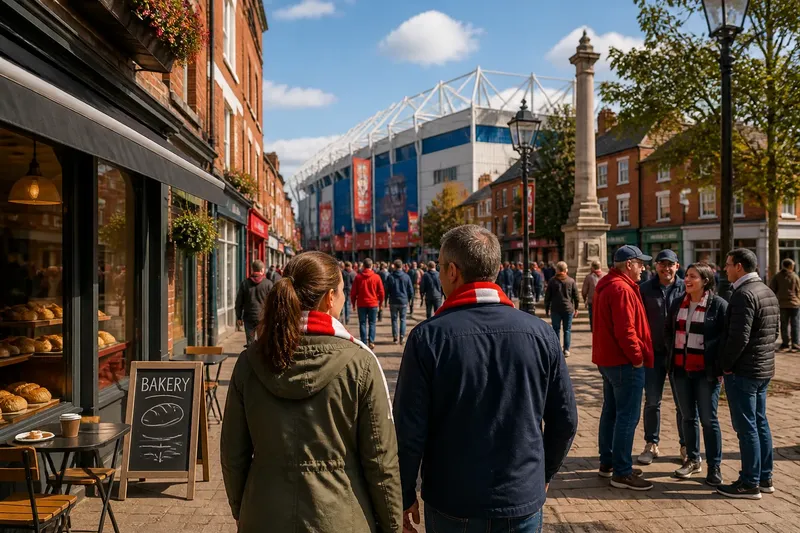
Imagine Maya, who has recently started attending her local football club’s home games with her neighbor Len. They usually meet near a bakery, walk along the same high street, and reach the ground together. The route is familiar, but at first it is just a convenient way to get there.
On one Saturday, Maya arrives early. Len asks whether she wants to stop at the bakery for tea before they walk. They do, then take their usual route past shop windows and a small square where supporters gather. Nothing about the path has changed. What changes is the attention they give it: they have made room for the match and for each other.
That distinction matters. Repetition alone can make an action automatic. A ritual usually involves some sense of intention, even if the action is simple: meeting someone, pausing at a familiar corner, or greeting the same vendor. The intention need not be solemn. It can be as modest as saying, “This is how we begin our afternoon.”
A small shared choice
At the square, Len recognizes a group of regulars and exchanges a few words. Maya has seen them before but hasn’t joined in. Len introduces her, and one supporter asks how she came to follow the club. Maya tells a short story about watching a match with her aunt as a child. The conversation turns to the game ahead, then to the weather and a nearby café.
In this invented situation, the action is meeting at the square; the intention is to welcome one another into the matchday; the expected result is that Maya has a familiar face to greet next time. The gesture itself does not prove that everyone in the group feels close. It simply creates an opening for recognition, which each person can meet in their own way.
That is one reason a ritual can be communal without demanding identical feelings. A chorus, a handshake, or a pause before entering may carry different private associations for different people. Shared meaning can be a common point of contact, not a single interpretation imposed on a crowd.
Meaning in repetition
At the ground, the group hears a familiar call from the terrace. Some join in at once; others listen, smile, or keep talking. Maya recognizes the tune from earlier visits. This time she follows the words and finds herself singing part of the refrain. Len joins, too, though he has told her he doesn’t think much about the song’s history.
For one supporter, the refrain might recall a parent who sang it. For another, it may express hope for the team or simply make a crowded stand feel less anonymous. A newer fan might enjoy learning the words without knowing any backstory. Those readings can sit beside one another. The ritual’s force comes partly from the shared act, while its personal significance remains open.
A matchday ritual is a little like a kitchen table: the object stays in place, but the people gathered around it bring different stories. The comparison is not exact, but it helps explain why a repeated action can feel meaningful without requiring a uniform explanation.
What changes, what stays?
After the match, Maya and Len take the same route back. They stop at the bakery again, but this time the shop is closing. Len suggests a nearby café instead, and Maya agrees. Their afternoon still has a familiar shape, but the ritual has not become a rigid script. They can keep its purpose—time together after the game—while changing one part of the routine.
Say the invented pair later misses a home match because Maya is visiting family. They send each other a brief message during the afternoon, then meet at the bakery before the next game. The expected observable result is modest: the missed week does not erase their connection, and their next meeting still feels recognizable. A ritual can survive a changed detail when its meaning matters more than perfect repetition.
This flexibility separates a living ritual from a rule that people feel pressured to obey. If a song, route, or gathering stops feeling welcome, supporters may adapt it, skip it, or choose another way to mark the day. A ritual can invite participation without becoming a test of loyalty.
When does it feel like a ritual?
Does repetition alone make an action a ritual?
No. Repeating an action can make it a routine, but ritual also involves meaning or intention for the people taking part. That meaning might be quiet and personal rather than announced.
Does everyone need to share the same meaning?
No. People can join the same chant or meeting point for different reasons, or take part without a strong personal attachment. Shared participation does not require shared interpretation.
Can a ritual change from match to match?
Yes. A gathering may move indoors when the weather turns, or a familiar greeting may become a message when someone cannot attend. The central meaning can remain even as the details shift.
What if I’m new to a club?
Begin by noticing what people do and whether there is an easy, respectful way to join. Listening first, asking a companion about a familiar custom, or offering a simple greeting can be enough; there is no need to perform a tradition you do not understand.
Joining at your own pace
For a newcomer, the hardest part may be deciding whether a custom is open to participation. A regular gathering in a public place, a shared song, or a greeting at the gate may offer a natural entry point. Watch how people respond, and remember that enjoying the match quietly is also a valid way to belong.
It helps to notice what the action asks of you. Does it leave room for a newcomer? Does it depend on knowing a private history, or can someone take part by listening? A generous ritual makes room for different levels of familiarity. It does not require a supporter to prove how long they have cared about the club.
Rituals can also change as a community changes. A group may welcome a new phrase, move a regular meeting spot, or make space for people who attend differently. Those changes do not automatically weaken a tradition. They may show that people are still choosing to give it meaning together.
The meaning travels
By the end of Maya and Len’s invented matchday, no single action has transformed the afternoon on its own. The bakery stop gave them time; the square offered a chance to meet others; the song brought different memories into one shared sound. Each part could remain ordinary in another setting. Together, by choice and repetition, they mark a day as a matchday.
That is why a matchday ritual feels different from a routine: it carries attention and relationship, not just repetition. You can look for that difference in the small choices around a game—who makes room at the table, who teaches a line of a song, or who notices when someone is missing. The next time you join a familiar custom, consider what it makes possible for the person beside you; that answer may matter more than knowing its one “correct” meaning.