A First Visit to a Community Sports Ground: Notice the Shared Spaces
A first visit to a community sports ground feels easier when you know where to pause, what to notice, and how shared spaces welcome different visitors.
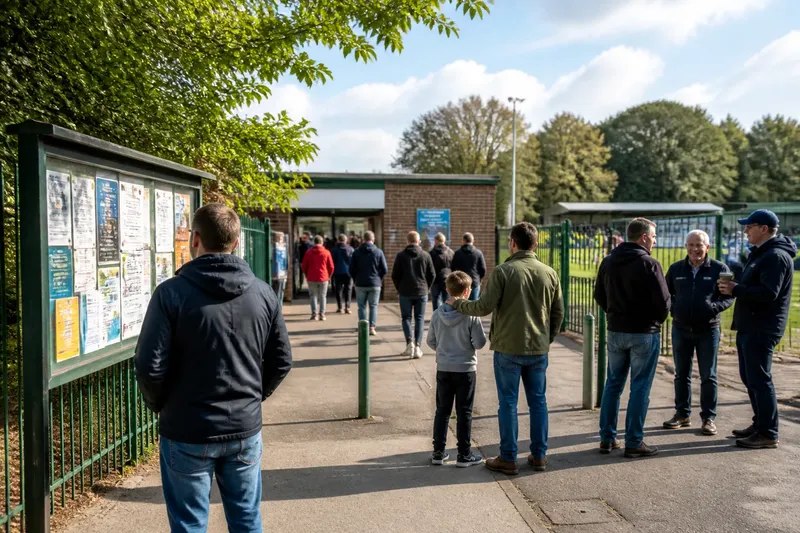
Where should you look first on a first visit to a community sports ground: the entrance, the busiest corner, or the pitch? Start with the shared spaces between them. They show how people arrive, wait, meet, and find their place, often before the match gives you anything to follow.
You do not need to know the club’s history or recognize every face. Think of the ground as a well-used kitchen: the doorway, the table, and the path through the room each tell you how people use the place. Choose an observation style that fits your situation, and let your own pace set the visit.
If You Arrive Alone
If you are coming by yourself, choose a spot where you can pause without blocking anyone. The edge of a forecourt, a noticeboard set back from a doorway, or a public path beside the grounds may give you room to take in the layout. Watch how people move rather than trying to read every sign at once.
Notice whether arriving spectators head straight to a gate, stop to greet someone, or check a board first. A cluster near a fence may be waiting for friends; a line that forms closer to a staffed entrance may be moving toward admission. These small patterns can help you understand the space without asking anyone to explain it.
If you want a little orientation, read public signs and posted notices, then move on if people need access. A ground may have separate routes for spectators, players, staff, or accessible entry. Follow the signs rather than guessing from a crowd’s direction.
If You Bring Someone
With a friend or family member, treat the first few minutes as a shared look around, not a race to find the best view. Agree on a meeting point that is easy to describe, such as a named entrance or a clearly marked public noticeboard. “By the main gate” may be too vague if several gates look alike.
Then notice where other pairs and groups gather. Some may stand outside the entrance to catch up; others may drift toward a food counter, a sheltered edge, or a place where they can watch warm-ups. You can see which spaces invite a brief stop and which are mainly routes through the ground.
Say you arrive with a friend who has never visited, and the entrance area is busy. You could pause beside a public map, agree to meet there if you get separated, and watch how spectators branch toward different gates. The expected result is a clearer sense of where the crowd is heading and a practical shared reference point, without needing to copy its pace.
If You Have Little Time
If your visit is brief, focus on the threshold: the point where the public approach meets the ground’s entrances. Look for the change in sound, pace, and activity as people move closer to admission. That transition can tell you more than a hurried circuit of the site.
Notice what is visible from outside. A community ground may make its identity legible through a club sign, a painted wall, a public notice, or a view toward the pitch. The details vary, but ask yourself what a passerby could understand without entering: where the ground is, what takes place there, and which way visitors are meant to go.
Do not assume every visible entrance is open to spectators. A gate may serve a different purpose, or be closed outside a particular event. Public signs and staff directions are a better guide than appearance alone.
If You Want Local Context
If you are curious about how the ground fits into neighborhood life, look for the spaces people use before and after the event. A public path running beside the boundary, a community noticeboard, or a meeting point near the entrance may connect matchday with ordinary local routines. Notice the connection without treating every nearby person as part of the spectacle.
Pay attention to what is shared and what is reserved. A bench might be open to passersby, while a seating area inside the gate is for ticket holders. A sign, barrier, or change in paving can mark that difference. Respecting it lets you observe the ground without turning someone else’s everyday route into your viewing position.
If you would like to learn more, ask a staff member or volunteer a simple, specific question at a quiet moment, such as which entrance is open to visitors. Avoid interrupting someone who is managing a queue or helping a spectator. A short, courteous exchange is often more useful than trying to infer local customs from a distance.
What Should You Notice?
Where do people stop?
Look for pauses at signs, gates, fences, and meeting points. A place where people naturally wait may serve as an informal landmark, while a clear stream of movement suggests that the area should stay open.
Which routes feel public?
Follow marked spectator routes and notice where access changes. Signs, barriers, and staffed entrances help distinguish a public approach from spaces intended for teams or ground workers.
What can you see before entering?
From the public side, look for the club’s name, event information, and directions. These details shape a first impression by showing how much a new visitor can learn before reaching the gate.
Where can you pause comfortably?
Look for a place that is out of the flow and does not block a doorway, path, or accessible route. If no such spot is clear, keep moving and take in the layout as you go.
Choose Your Pace
There is no single right way to read a ground. A solo visitor may prefer a quiet pause; a group may want an agreed meeting point; someone with little time can focus on the entrance; and a locally curious visitor may pay attention to the boundary between event space and neighborhood space. The best fit is the one that lets you notice without getting in anyone’s way.
On your first visit to a community sports ground, shared spaces offer a gentle way in. Start with one visible detail, such as a sign or a gathering spot, then notice how people use the space around it. If you leave with a clearer sense of where visitors meet, move, and pause, you have already learned something meaningful about the ground’s place in community life.
Before you go, check the ground’s posted visitor information for event access and any local directions. If you return, compare the same public spaces at a different point in the day; a familiar entrance can feel entirely different when people are arriving, leaving, or simply passing by.